

Why You’ll Love This Pot Roast Recipe
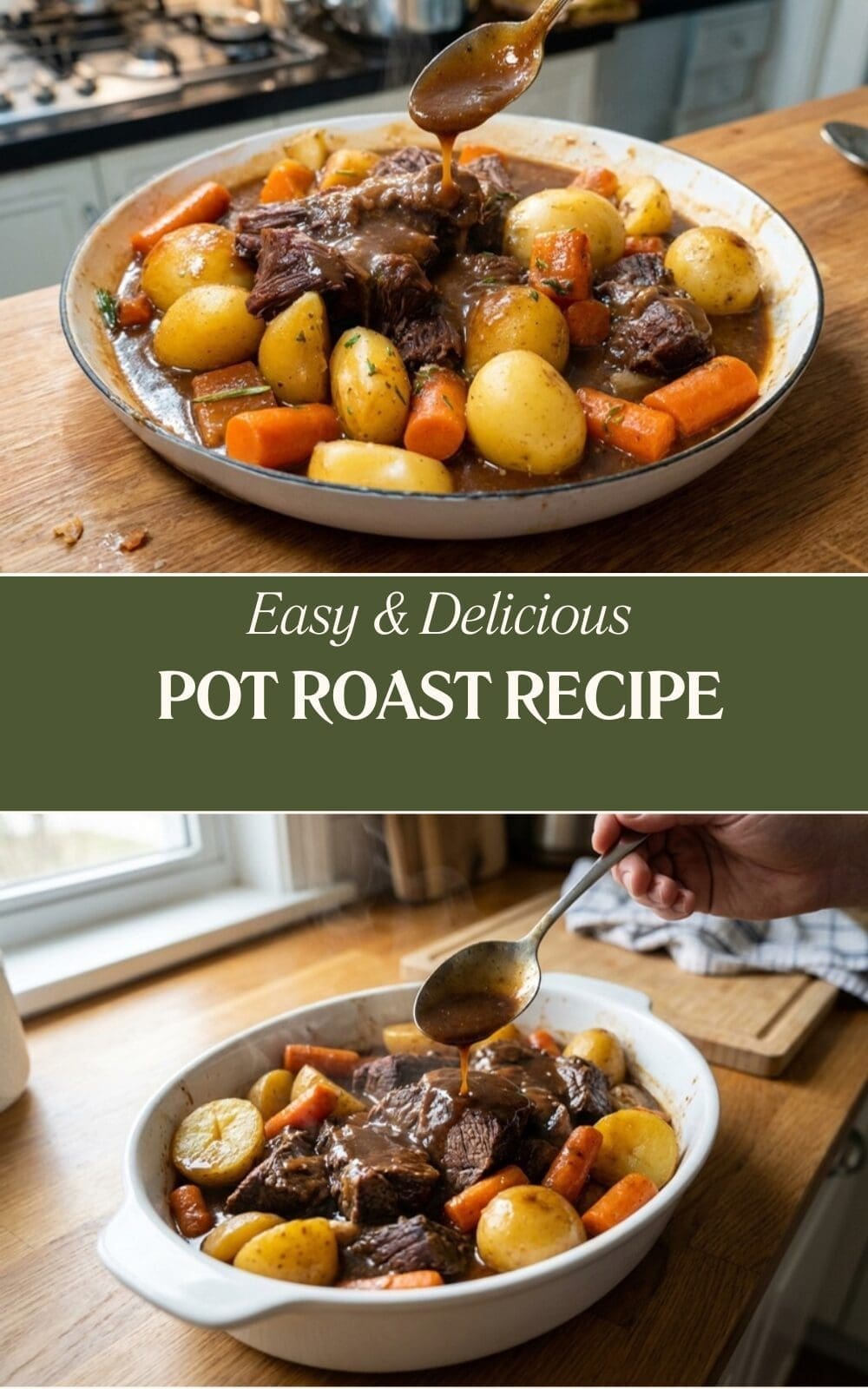
This Pot Roast Recipe is a classic family favorite that gives you fork-tender beef, a savory braising liquid, and hands-off cooking that fits busy weeknights or relaxed Sunday dinners. It uses simple pantry ingredients and a slow, low oven to turn an economical cut of beef into a hearty, satisfying meal the whole family will love.
- Ease of preparation: With just a few minutes of prep seasoning, a quick sear, and layering vegetables you can set the pot in the oven and let it cook. Active time is short while oven time does the heavy lifting.
- Health benefits: This recipe balances protein and vegetables and can fit into many meal plans. With controlled portions and simple ingredients, it provides protein, fiber, and vitamins without complicated sauces.
- Versatility: The pot roast is easy to adapt for slow cookers, smaller roasts, or different vegetables. It can be made gluten-free, lighter, or richer depending on your choices.
- Distinctive flavor: The combination of seared beef, beef broth, red wine, garlic, rosemary, and thyme creates a deep, comforting flavor that develops during long braising.
“A simple roast that tastes like you spent all day in the kitchen even when you didn’t.”
Jump To
- 1. Why You’ll Love This Pot Roast Recipe
- 2. Essential Ingredients for Pot Roast Recipe
- 3. How to Prepare the Perfect Pot Roast Recipe: Step-by-Step Guide
- 4. Dietary Substitutions to Customize Your Pot Roast Recipe
- 5. Mastering Pot Roast Recipe: Advanced Tips and Variations
- 6. How to Store Pot Roast Recipe: Best Practices
- 7. Nutrition and Timing
- 8. Tips and Tricks
- 9. FAQs: Frequently Asked Questions About Pot Roast Recipe
- 10. Pot Roast Recipe
Essential Ingredients for Pot Roast Recipe
Below is a clear, structured list of every ingredient with exact measurements so you can shop and prep with confidence.
- 1 tablespoon olive oil – used for searing the roast to create a flavorful crust.
- 3 to 4 pounds beef chuck roast or rump roast – the main protein; chuck gives great marbling and tenderness.
- 1 large yellow onion, chopped (or two small onions) – builds the savory base.
- 2 cups beef broth (or as needed) – braising liquid that keeps the meat moist and forms the base for gravy.
- 1 cup red wine (can be replaced with additional beef broth) – adds depth; replace with broth if preferred.
- 4 cloves garlic, coarsely chopped – aromatics for savory flavor.
- 1/2 teaspoon dried rosemary (or 1 1/2 teaspoons fresh) – herbaceous note.
- 1/2 teaspoon dried thyme leaves (or 1 1/2 teaspoons fresh) – pairs with rosemary for classic braise flavors.
- 1 bay leaf – adds subtle background flavor during long cooking.
- 1 pound baby potatoes (or chopped red potatoes) – hold shape and absorb juices.
- 4 carrots, cut into 2-inch pieces – sweet, hearty vegetable to round out the pot.
- 2 ribs celery, cut into 1 1/2-inch pieces – adds aromatic backbone and texture.
For the Gravy
- 2 tablespoons cornstarch or flour – thickener for a quick slurry-based gravy.
- Butter (for optional roux-based gravy: 4 tablespoons flour and 4 tablespoons butter) – used if making a richer roux gravy.
How to Prepare the Perfect Pot Roast Recipe: Step-by-Step Guide
The steps below are written for an oven braise in a Dutch oven at 300°F. Read through once before you start and have ingredients measured and ready.
First Step: Prep and mise en place
Preheat the oven to 300°F. Pat the roast dry with paper towels and season generously with salt and pepper on all sides. Chop the onion, peel and cut the carrots into 2-inch pieces, cut celery into 1 1/2-inch pieces, and leave the baby potatoes whole or halve larger pieces. Measure out the broth, wine, garlic, and herbs.
Second Step: Sear the roast
Heat 1 tablespoon olive oil in a large Dutch oven over medium-high heat. When the oil is shimmering, place the roast in the pot and sear until well browned on each side, about 4 minutes per side. Searing builds a savory crust and adds flavorful browned bits to the pot that improve the final gravy.
Third Step: Build the braising liquid
Arrange the chopped onion around the roast. In a measuring cup or small bowl, combine 2 cups beef broth, 1 cup red wine (or extra beef broth if you prefer no alcohol), 4 cloves coarsely chopped garlic, 1/2 teaspoon dried rosemary (or 1 1/2 teaspoons fresh), 1/2 teaspoon dried thyme (or 1 1/2 teaspoons fresh), and 1 bay leaf. Pour the mixture over the roast and bring to a gentle simmer on the stovetop for a few minutes to meld flavors.
Fourth Step: Oven braise
Cover the Dutch oven with a tight-fitting lid and place it in the preheated oven. Cook for 2 hours, keeping the lid on to trap steam and promote even cooking.
Fifth Step: Add vegetables and continue cooking
After 2 hours, remove the pot and add 1 pound baby potatoes, 4 carrots cut into 2-inch pieces, and 2 ribs celery cut into 1 1/2-inch pieces around the roast. Cover and return to the oven for an additional 2 hours, or until the roast and potatoes are fork-tender. Total oven time is about 4 hours.
Final Step: Finish and serve
Remove the pot from the oven. Discard the bay leaf. Pull the beef into large pieces with forks or slice thickly against the grain. Serve the meat and vegetables with the pan juices, or follow the gravy instructions below to make a smooth sauce.
How to Make Gravy
Quick slurry method:
- Whisk 2 tablespoons cornstarch or flour with about 1/4 cup cold water until smooth to make a slurry.
- Remove beef and veggies from the pot and set aside. Pour the braising liquid into a saucepan and skim off excess fat.
- Bring the remaining liquid to a boil and gradually whisk in the slurry. Cook 2 to 3 minutes until thickened. Season with salt and pepper to taste.
Optional roux-based gravy:
- Melt 4 tablespoons butter in a saucepan, stir in 4 tablespoons flour and cook for 2 minutes to make a roux.
- Gradually whisk in the skimmed drippings and remaining braising liquid until smooth. Bring to a boil for 1 minute and season with salt and pepper.

Dietary Substitutions to Customize Your Pot Roast Recipe
Protein and Main Component Alternatives
If you need a different main protein or are working with availability or diet preferences, try these swaps:
- Beef alternatives: For a leaner option, use rump roast or round roast, remembering cooking time may vary slightly. For a slower-cooked texture in a slow cooker, keep the same cut but reduce liquids per slow-cooker guidance below.
- Plant-based option: Replace beef with a large portobello roast or a seitan roast and use vegetable broth and red wine substitute. Shorter cook times are typical; check for desired texture frequently.
- Smaller roast adjustments: For a 2-pound roast, reduce oven time and start checking for tenderness after about 2 to 2 1/2 hours.
Vegetable, Sauce, and Seasoning Modifications
Vegetables and seasonings can shift the dish toward different flavor profiles or meet dietary needs.
- Vegetable swaps: Use sweet potatoes, turnips, parsnips, or mushrooms for a different taste and texture. If using russet potatoes, cut larger and add later to avoid them falling apart.
- Gluten-free gravy: Use cornstarch instead of flour for a gluten-free slurry. Mix cornstarch with cold water before adding to hot liquid to prevent lumps.
- Low-calorie options: Trim visible fat, use only 1 cup broth and 1/2 cup wine (or extra broth) for less liquid to reduce calories from drippings, and skip the roux butter to cut saturated fat.
- Herb swaps: Fresh herbs can replace dried at a 3:1 ratio. Use rosemary, thyme, or a bay leaf as listed; add a sprig of parsley at the end for brightness.
Mastering Pot Roast Recipe: Advanced Tips and Variations
This section gives extra guidance for readers who want to take their pot roast beyond the basics, with pro techniques, flavor swaps, and presentation ideas.
Pro cooking techniques
- Searing: Brown the roast well in hot oil to develop flavor. If time is tight, a quick sear will still help the gravy taste richer.
- Even braising: Use a heavy, lidded pot like a Dutch oven for consistent heat distribution. If you don’t have one, use an oven-safe pot with a tight lid or cover tightly with foil.
- Low-and-slow: Keep oven at 300°F and avoid lifting the lid during cooking. The trapped moisture helps break down connective tissue into tender gelatin.
Flavor variations
- Red wine blend: Use a dry cabernet sauvignon, malbec, merlot, or cabernet franc for depth. If you prefer no alcohol, replace wine with equal beef broth and a splash of balsamic vinegar for acidity.
- Spiced version: Add 1/2 teaspoon smoked paprika and a pinch of crushed red pepper for warmth.
- Herb-forward: Add a small bunch of fresh thyme and rosemary tied together so you can remove easily before serving.
Presentation tips
- Slice or shred: For rustic family-style service, pull the beef into large pieces. For a more formal plate, slice thickly against the grain and arrange vegetables around the meat.
- Garnish: Sprinkle chopped fresh parsley over the gravy for color and brightness.
Make-ahead options
- Cook ahead: Fully cook the roast, cool to room temperature, refrigerate, then reheat gently in a 325°F oven covered until hot. This makes weekday reheating quick and reliable.
- Meal prep: Store meat and vegetables together in airtight containers for up to 4 days in the fridge or freeze for up to 3 months.
How to Store Pot Roast Recipe: Best Practices
Refrigeration
Cool the roast and vegetables to room temperature, then place in airtight containers. Store in the refrigerator up to 4 days. To keep gravy from separating, store it in a separate container if possible.
Freezing
For long-term storage, freeze in freezer-safe containers or heavy-duty bags for up to 3 months. Remove as much air as possible to prevent freezer burn. Thaw overnight in the refrigerator before reheating.
Reheating
Reheat gently to preserve texture: warm in a 325°F oven covered until heated through, or reheat on the stovetop over low heat with a splash of broth to keep meat moist. Avoid high heat which can dry the meat.
Meal prep considerations
Portion into family-size or single-meal containers for quick lunches or dinners. To stretch a meal, serve with mashed potatoes, roasted vegetables, or a simple salad. A good make-ahead mashed potato recipe pairs well with this roast and saves time at serving; try this make-ahead mashed potato casserole for a ready side.
Nutrition and Timing
| Nutrient (per serving) | Amount |
|---|---|
| Calories | 419 |
| Carbohydrates | 16g |
| Protein | 35g |
| Fat | 22g |
| Saturated Fat | 9g |
| Cholesterol | 117mg |
| Sodium | 396mg |
| Potassium | 1032mg |
Preparation Time
- Prep Time: 25 minutes
- Cook Time: 4 hours 10 minutes
- Total Time: 4 hours 35 minutes
Tips and Tricks
Below are practical pointers to get the most from this pot roast:
- Best cuts: Choose chuck roast or boneless beef blade roast for marbling and flavor; rump roast or round roast are good leaner alternatives.
- Pick roasts with good marbling for richer gravy and tenderness.
- Cook onions with the roast for built-in flavor. Add extra chopped onions with the vegetables if you like larger pieces.
- Use baby potatoes as they hold their shape; russets can break down during long braises.
- Cut carrots and celery larger to prevent overcooking; feel free to add mushrooms, turnips, or sweet potatoes for variety.
- Use regular beef broth and red wine for deeper flavor. If you prefer, replace red wine with more beef broth.
- If you do not have a Dutch oven, use an oven-safe pot with a lid, a deep roasting pan tightly covered with foil, or a casserole dish with an oven-safe lid.
- For slow cooker: reduce broth to 1 cup and wine to 1/2 cup; cook 8-10 hours on low or 4-6 hours on high. Low setting gives the most tender result.
- Searing helps develop a flavorful crust and improves gravy, but it is optional if you are short on time.
- Don’t use a thermometer to judge doneness; the roast is done when fork-tender and easily pulls apart.
- Store leftovers in the fridge up to 4 days or freeze up to 3 months.
- To stretch the meal, serve with mashed potatoes or green vegetables.
- Keep the lid on while cooking in the oven to keep moisture trapped.
- Use triple the amount of fresh herbs compared to dried if substituting fresh for dried.
- For smaller roasts around 2 pounds, reduce cooking time and check for tenderness earlier.
- Do not partially cook and refrigerate; fully cook then reheat when ready to serve.
FAQs: Frequently Asked Questions About Pot Roast Recipe
What cut of beef is best for pot roast?
The best cuts for pot roast are chuck roast or boneless beef blade roast because they have plenty of marbling and connective tissue that break down during slow cooking, creating tender meat and rich gravy. Round roast or rump roast also work well if you want leaner options. Aim for a 3-5 pound roast for a standard family meal. Before cooking, pat the meat dry and season generously with salt and pepper. These tougher cuts need low, slow heat—around 300°F in the oven—to transform into fork-tender perfection. Avoid lean cuts like sirloin, as they dry out easily. For best results, sear the roast first in a hot Dutch oven with oil to lock in flavor. (92 words)
What vegetables should I use in pot roast?
Baby potatoes are ideal because they hold their shape without peeling and cook evenly. Cut carrots and celery into large chunks to prevent mushiness. Add mushrooms, turnips, or sweet potatoes for variety—they absorb the savory broth beautifully. Place vegetables around the roast in the pot after searing the meat. Use about 1.5 pounds of mixed veggies for a 4-pound roast. Onions and garlic provide a flavor base; quarter 2 onions and smash 4 garlic cloves. Fresh herbs like rosemary and thyme (1 tsp dried each or 1.5 tsp fresh) tie it all together. Simmer covered until veggies are fork-tender, about 3-4 hours total. This combo yields balanced texture and taste. (112 words)
How long do you cook pot roast in the oven?
Cooking time depends on roast size: 3-pound roast takes 3-3.5 hours; 4-pound needs 3.5-4 hours; 5-pound requires 4.5-5 hours at 300°F. Start by searing the meat, add 2 cups broth and 1 cup wine (or extra broth), then cover tightly. Check doneness by inserting a fork—it should twist easily and meat should shred. If not tender, cook 20-30 more minutes. Total internal temp should reach 205°F for pull-apart texture. Rest 15 minutes before slicing. Factors like pot size and oven accuracy affect time, so rely on tenderness test over clock. Always use a heavy lidded pot like a Dutch oven for even heat. (118 words)
Can you cook pot roast in a slow cooker?
Yes, slow cookers make pot roast effortless and tender. Use a 4-pound chuck roast, sear if possible, then add to cooker with 1 cup beef broth, ½ cup red wine (or broth), onions, carrots, celery, baby potatoes, and herbs. Cook on low 8-10 hours or high 4-6 hours until fork-tender. Low setting yields best results as it mimics oven braising. No need to stir; just set and forget. Thicken gravy at end by removing meat/veggies, skimming fat, and whisking in a cornstarch slurry (2 tbsp cornstarch + ¼ cup water). Serves 6-8 with minimal cleanup. Perfect for busy days. (104 words)
How do you make pot roast gravy?
For rich gravy, remove roast and veggies from pot. Let drippings settle, skim off excess fat. Pour juices into a saucepan (about 2 cups). Whisk 2 tbsp cornstarch or flour with ¼ cup cold water to form a slurry. Bring juices to simmer over medium heat, slowly whisk in slurry, and cook 2-3 minutes until thickened. Taste and season with salt, pepper, and a splash of Worcestershire if needed. For extra flavor, stir in pan bits or a pat of butter. Makes 2 cups—enough to drizzle over meat and sides. This simple step turns drippings into silky sauce in under 10 minutes. Store leftovers in fridge up to 4 days. (114 words)

Pot Roast Recipe
🥩 Tender, melt-in-your-mouth beef that brings the whole family together around the dinner table
🍲 Classic comfort food that fills your home with amazing aromas and creates lasting memories
- Total Time: 4 hours 35 minutes
- Yield: 6-8 servings
Ingredients
– 1 tablespoon olive oil used for searing the roast to create a flavorful crust
– 3 to 4 pounds beef chuck roast or rump roast the main protein
– 1 large yellow onion, chopped (or two small onions) builds the savory base
– 2 cups beef broth (or as needed) braising liquid that keeps the meat moist and forms the base for gravy
– 1 cup red wine (can be replaced with additional beef broth) adds depth
– 4 cloves garlic, coarsely chopped aromatics for savory flavor
– 1/2 teaspoon dried rosemary (or 1 1/2 teaspoons fresh) herbaceous note
– 1/2 teaspoon dried thyme leaves (or 1 1/2 teaspoons fresh) pairs with rosemary for classic braise flavors
– 1 bay leaf adds subtle background flavor during long cooking
– 1 pound baby potatoes (or chopped red potatoes) hold shape and absorb juices
– 4 carrots, cut into 2-inch pieces sweet, hearty vegetable to round out the pot
– 2 ribs celery, cut into 1 1/2-inch pieces adds aromatic backbone and texture
– 2 tablespoons cornstarch or flour thickener for a quick slurry-based gravy
– 4 tablespoons flour for optional roux-based gravy
– 4 tablespoons butter for optional roux-based gravy
Instructions
1-First Step: Prep and mise en place Preheat the oven to 300°F. Pat the roast dry with paper towels and season generously with salt and pepper on all sides. Chop the onion, peel and cut the carrots into 2-inch pieces, cut celery into 1 1/2-inch pieces, and leave the baby potatoes whole or halve larger pieces. Measure out the broth, wine, garlic, and herbs.
2-Second Step: Sear the roast Heat 1 tablespoon olive oil in a large Dutch oven over medium-high heat. When the oil is shimmering, place the roast in the pot and sear until well browned on each side, about 4 minutes per side. Searing builds a savory crust and adds flavorful browned bits to the pot that improve the final gravy.
3-Third Step: Build the braising liquid Arrange the chopped onion around the roast. In a measuring cup or small bowl, combine 2 cups beef broth, 1 cup red wine (or extra beef broth if you prefer no alcohol), 4 cloves coarsely chopped garlic, 1/2 teaspoon dried rosemary (or 1 1/2 teaspoons fresh), 1/2 teaspoon dried thyme (or 1 1/2 teaspoons fresh), and 1 bay leaf. Pour the mixture over the roast and bring to a gentle simmer on the stovetop for a few minutes to meld flavors.
4-Fourth Step: Oven braise Cover the Dutch oven with a tight-fitting lid and place it in the preheated oven. Cook for 2 hours, keeping the lid on to trap steam and promote even cooking.
5-Fifth Step: Add vegetables and continue cooking After 2 hours, remove the pot and add 1 pound baby potatoes, 4 carrots cut into 2-inch pieces, and 2 ribs celery cut into 1 1/2-inch pieces around the roast. Cover and return to the oven for an additional 2 hours, or until the roast and potatoes are fork-tender. Total oven time is about 4 hours.
6-Final Step: Finish and serve Remove the pot from the oven. Discard the bay leaf. Pull the beef into large pieces with forks or slice thickly against the grain. Serve the meat and vegetables with the pan juices, or follow the gravy instructions below to make a smooth sauce.
7-How to Make Gravy Quick slurry method: 1. Whisk 2 tablespoons cornstarch or flour with about 1/4 cup cold water until smooth to make a slurry. 2. Remove beef and veggies from the pot and set aside. Pour the braising liquid into a saucepan and skim off excess fat. 3. Bring the remaining liquid to a boil and gradually whisk in the slurry. Cook 2 to 3 minutes until thickened. Season with salt and pepper to taste. Optional roux-based gravy: 1. Melt 4 tablespoons butter in a saucepan, stir in 4 tablespoons flour and cook for 2 minutes to make a roux. 2. Gradually whisk in the skimmed drippings and remaining braising liquid until smooth. Bring to a boil for 1 minute and season with salt and pepper.
Notes
🥩 Choose roasts with good marbling for the most flavorful and tender results
🍷 Red wine adds depth but can be replaced with additional beef broth for a non-alcoholic version
⏰ For slow cooker: reduce broth to 1 cup and wine to ½ cup; cook 8-10 hours on low
- Prep Time: 25 minutes
- Cook Time: 4 hours 10 minutes
- Category: Main Dish
- Method: Braising
- Cuisine: American
- Diet: Non-Vegetarian
Nutrition
- Serving Size: 1 serving
- Calories: 419
- Sugar: 3
- Sodium: 396
- Fat: 22
- Saturated Fat: 9
- Unsaturated Fat: 13
- Carbohydrates: 16
- Fiber: 3
- Protein: 35
- Cholesterol: 117


